Introduction
The textile industry uses a wide range of yarns to meet different production needs. Each type of yarn has unique properties that affect fabric performance and quality.
Types of Yarn
Cotton yarn is widely used for its softness and comfort. Polyester yarn is known for its strength and durability. Blended yarn combines the advantages of multiple fibers. Wool yarn provides warmth, while silk yarn is used in luxury fabrics. Organic yarn is eco-friendly, and recycled yarn supports sustainability.
1. Combed and Carded Cotton Yarn
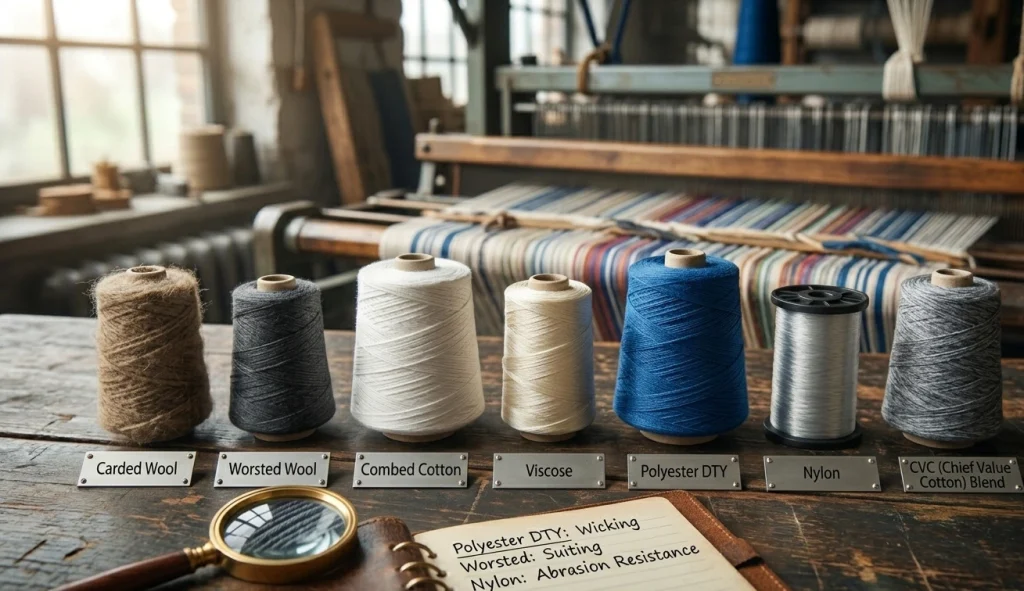
Cotton remains the “king” of the industry. The primary distinction in manufacturing is between carded and combed yarns.
- Carded Yarn: Contains fibers of varying lengths, resulting in a slightly fuzzy surface. It is cost-effective and used for denim and basic tees.
- Combed Yarn: Undergoes an extra step to remove short fibers and impurities. This produces a much smoother, stronger, and more premium yarn used for high-end shirting and luxury linens.
2. Polyester Filament Yarn
Polyester is the workhorse of synthetic textiles. Unlike natural fibers that are spun together, polyester is often produced as a continuous filament.
- Drawn Textured Yarn (DTY): Processed to have a soft, crimped texture. It is the primary choice for activewear due to its moisture-wicking properties.
- Fully Drawn Yarn (FDY): A smooth, high-speed yarn used for ribbons, upholstery, and home textiles where a high-sheen finish is required.
3. Woolen and Worsted Yarn
Animal fibers are categorized by the “Worsted” and “Woolen” systems, which dictate the yarn’s final density.
- Worsted: Fibers are combed to lie parallel, creating a smooth, compact yarn. Think of a sleek, expensive tailored suit.
- Woolen: Fibers are crisscrossed and airy, resulting in a soft, bulky yarn with excellent insulation. This is the standard for heavy winter sweaters and blankets.
4. Viscose (Rayon) Yarn
Known as a “regenerated” fiber, viscose is made from wood pulp. It is prized in manufacturing because it mimics the drape of silk and the breathability of cotton but at a much lower price point. It is highly absorbent, making it a favorite for women’s fashion and summer wear.
5. Nylon (Polyamide) Yarn
Nylon is the go-to for industrial-strength textiles. It is exceptionally durable, elastic, and resistant to abrasion.
- Applications: It dominates the hosiery (stockings), swimwear, and outdoor gear markets. Its ability to “snap back” to its original shape makes it indispensable for performance garments.
6. Blended Yarns (CVC and PC)
Blended yarns are engineered to fix the weaknesses of individual fibers.
- CVC (Chief Value Cotton): A blend where cotton is the dominant fiber (e.g., 60% Cotton / 40% Poly). It feels like cotton but has the wrinkle resistance of polyester.
- PC (Polyester-Cotton): A blend where polyester is dominant. These are highly durable, cheap to produce, and widely used for corporate uniforms and workwear.
7. Spandex (Elastane) Core-Spun Yarn
In modern manufacturing, spandex is rarely used alone. Instead, it is used as a “core” around which other fibers (like cotton or polyester) are wrapped. This core-spun technique allows a pair of jeans to look like 100% cotton but have 2% to 5% stretch, providing the “comfort stretch” modern consumers demand.
Comparison at a Glance
| Yarn Type | Key Strength | Typical End-Use |
| Combed Cotton | Softness & Purity | Luxury Apparel |
| Polyester DTY | Elasticity & Wicking | Sportswear |
| Worsted Wool | Smoothness & Durability | Professional Suiting |
| Viscose | Drape & Silkiness | High-fashion Dresses |
| Nylon | Abrasion Resistance | Outerwear / Hosiery |
| Blends | Versatility & Value | Bedding / Workwear |
| Core-Spun | Stretch Recovery | Denim / Leggings |
Conclusion
Investing in high-quality yarn is crucial for long-term success in the textile industry. It ensures better results and reduces production challenges.


