Introduction
High-quality yarn is essential for producing durable and attractive fabrics. It plays a key role in determining the strength, texture, and appearance of the final product.
1. Production Efficiency and Machine Downtime
The modern textile mill operates at extreme speeds. High-speed knitting machines and air-jet looms put immense tension on the yarn.
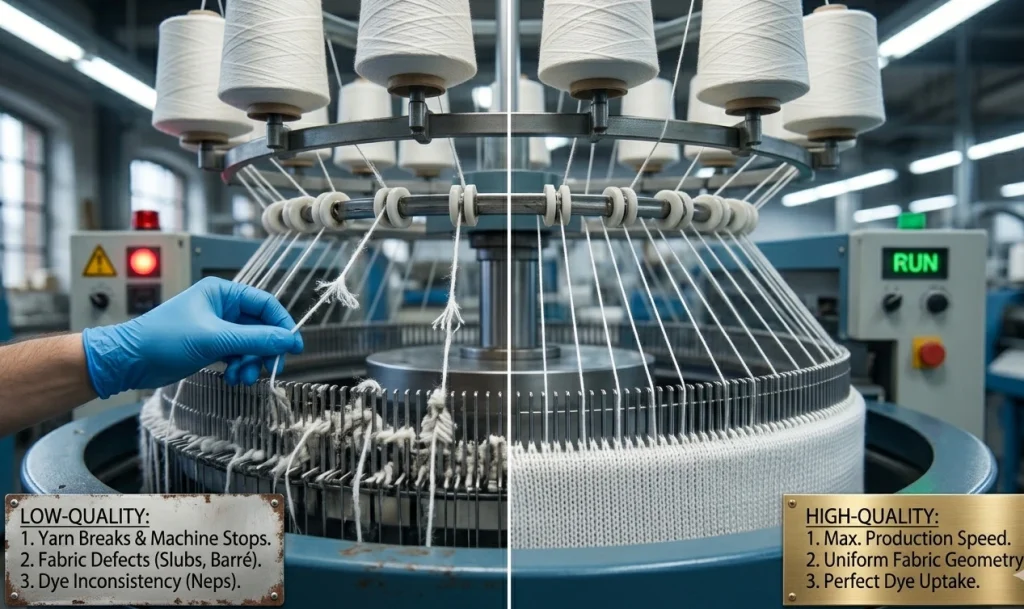
- The Cost of “Ends-Down”: Low-quality yarns often have weak points, slubs (unexpected thick spots), or inconsistent twists. Under tension, these weak points break. In spinning and weaving, this is called an “ends-down” event.
- The Impact: Every time a yarn breaks, the entire machine stops. A technician must manually re-thread the machine. For a large mill, just a 5% increase in breakages can reduce overall plant efficiency by 15-20%, leading to missed deadlines and increased labor costs. High-quality yarn has the tensile strength and elongation properties to survive high-speed manufacturing without failure.
2. Structural Integrity and Fabric Defect Reduction
The geometry of the fabric is entirely dependent on the geometry of the yarn.
- Inconsistent Yarn Count: If the yarn diameter varies (an issue common in low-grade carded cotton), the resulting fabric will have visible streaks, thick/thin bars (barré), or a patchy appearance.
- Skewing and Torque: Yarn must be “twist-set.” If low-quality yarn has latent torque (unbalanced twist), it will try to untwist after it is knitted or woven. This causes the entire fabric roll to skew or twist. This defect, known as spirality, makes it impossible to cut and sew garment panels accurately, as the side seams will twist around the body. High-quality yarn is balanced and twist-stabilized.
3. Predictable Dye Absorption and Colorfastness
Yarn quality directly impacts the chemistry of the dyeing process.
- Immature Fibers and Neps: Low-quality natural fibers often contain immature fibers or tightly knotted bundles called neps. These do not absorb dye the same way mature fibers do. The result is a finished fabric speckled with tiny white or pale dots, rendering the fabric “B-grade” or “C-grade.”
- Consistency is Key: High-quality yarn ensures that fiber maturity and molecular structure are consistent throughout the lot. This guarantees that the dye is absorbed evenly, resulting in perfect color matching from the first yard to the last.
4. Post-Production Performance and Pilling Resistance
The quality of the yarn determines how the final product behaves in the hands of the consumer.
- Abrasion and Pilling: Pilling (the formation of small fiber balls on the fabric surface) occurs when loose fiber ends migrate to the surface during friction. Low-quality yarn often has shorter fibers and a looser twist, facilitating this migration.
- The Solution: High-quality yarn, particularly combed cotton or compact-spun yarn, tucks the fiber ends tightly into the yarn core. This vastly improves the fabric’s resistance to pilling, extends the garment’s life, and maintains its brand-new appearance after multiple washes
Summary: The Total Cost of Ownership
When evaluating yarn, manufacturers must look beyond the quoted price per kilogram. They must consider the Total Cost of Ownership (TCO). High-quality yarn offers:
- Fewer machine stops (higher efficiency).
- Lower defect rates (higher fabric yield).
- Consistent dyeing (less re-work).
- Superior product longevity (brand reputation).
Conclusion: In textile manufacturing, high-quality yarn is not a luxury; it is the fundamental infrastructure required for cost-effective, high-grade fabric production.


