The difference between a “A-Grade” yarn that runs flawlessly at 1,000 RPM and a “B-Grade” yarn that snaps constantly is often invisible to the untrained eye. For textile buyers and quality control (QC) specialists, mastering the “hand-and-eye” inspection is critical.
Here are four definitive tests you should perform on any yarn sample.
1. The Pull-to-Break Strength Test (Tenacity)
Tensile strength (tenacity) is the most critical factor for machine efficiency. A high-quality yarn must have predictable elongation before it breaks.
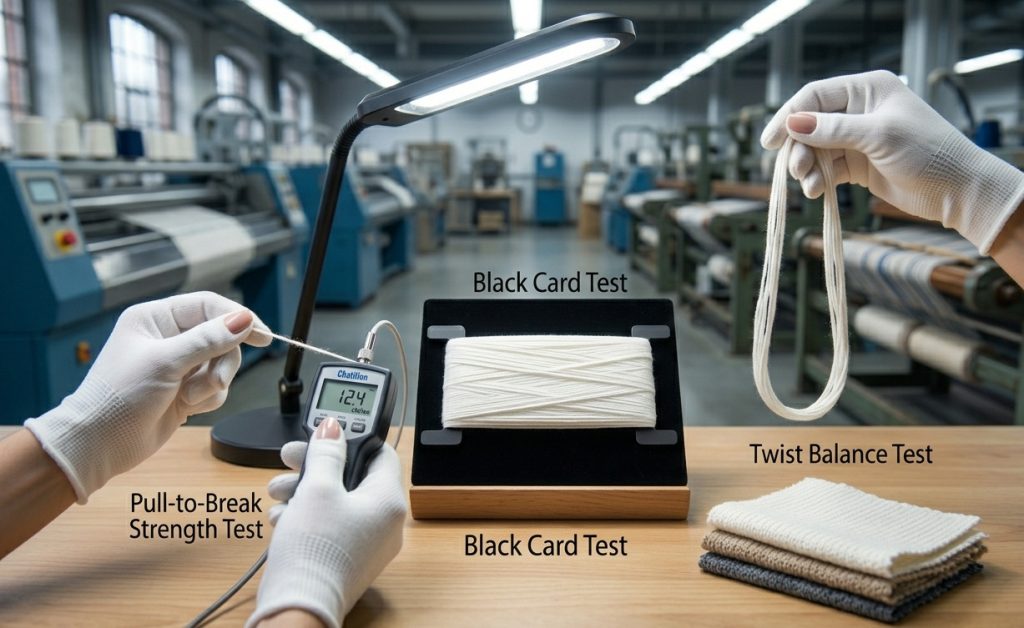
- The Test: Take a one-meter length of yarn. Wrap the ends securely around your index fingers (leaving about 10 inches between them). Pull slowly and steadily until the yarn snaps.
- Expert Observation:
- High-Quality: The yarn will stretch slightly (showing elasticity) and offer significant, consistent resistance before snapping cleanly.
- Low-Quality: The yarn will snap abruptly with very little pull, or worse, it will “shred” rather than snap, revealing weak points where the fibers are barely holding together. This yarn will not survive an air-jet loom.
2. The Visual Evenness and Slub Check (The Black Card Test)
Fabric defects like barré (streaking) often stem from yarn diameter variation. A visual inspection against contrast is the fastest way to spot these inconsistencies.
- The Test: Wind a sample of the yarn evenly around a rigid black card (or a specialized ‘black board’ used in textile labs). Ensure the wraps are close together but do not overlap. View the card under strong, directional light.
- Expert Observation:
- High-Quality: The yarn diameter appears uniform across the entire card. The surface is clean.
- Low-Quality: You will instantly see small, thick lumps (called slubs) and distinct thin spots. You may also see neps (tiny, dense fiber knots). These defects will translate directly into “thick-and-thin” faults in your finished fabric.
3. Twist Balance and Spirality Potential
A balanced twist is essential. If a yarn has latent torque (it wants to untwist), it will cause the final fabric to skew, a major defect known as spirality.
- The Test: Take a length of yarn (about 1 meter) directly from the cone. Hold both ends, allowing the center to form a loose loop or “U” shape. Gently bring your hands closer together, letting the loop hang freely.
- Expert Observation:
- High-Quality: The hanging loop will remain relatively smooth and neutral. It should not self-twist aggressively. This yarn is twist-stabilized.
- Low-Quality: The loop will immediately double back on itself, twisting tightly like a rope. This indicates high latent torque. This yarn is unstable and will likely cause significant skewing in knitted fabrics.
4. Friction and Pilling Resistance (The Rub Test)
Pilling is caused by loose fibers migrating to the surface during abrasion. High-quality yarn binds these fibers tightly to the core.
- The Test: Fold a sample of the yarn over your index finger. Using the thumb of your other hand, apply moderate pressure and vigorously rub the yarn surface back and forth about 20 times.
- Expert Observation:
- High-Quality: The yarn surface remains smooth and compact, perhaps only slightly fuzzier. The integrity holds.
- Low-Quality: The action quickly creates loose fiber ends. Small fiber balls (pills) may already be starting to form on the surface, or the fibers may start to separate entirely. This fabric will have very poor durability in the real world.
Conclusion: Trust, but Verify
By employing these four quick physical tests during procurement, you can move beyond specifications and gain a true understanding of the yarn’s performance potential. High-quality yarn selection is the single best investment you can make in your production efficiency and final fabric grade.


